Charing Cross Station, Glasgow City Centre
2026
We were engaged by CXG Glasgow Limited. Other key stakeholders include Reigart Contracts Ltd (Contractor/Demolition contractor) and Network Rail. The project is located at Charing Cross Station, Glasgow City Centre. The station services the North Clyde Line.
Background / Overview
This project is part of the larger £250 million Charing Cross Gateway masterplan approved by Glasgow City Council in 2024. The monitoring scheme is focused on a large retaining wall located between the existing development property (the former HMRC building, which is due to be knocked down) and the operating Charing Cross Station. The initial phase of the wider regeneration is a 620-bed student accommodation development on the south side of Bath Street. The underlying concern is the stability and integrity of the railway retaining wall during upcoming demolition and subsequent construction activities.
Client Challenge
The client faced a critical challenge: maintaining the stability and integrity of a key railway retaining wall positioned between the former HMRC building due to be demolished and the operational Charing Cross Station. With demolition and subsequent construction of a new 620-bed student accommodation development about to begin, ensuring the wall’s continued stability was essential to safeguard both the railway infrastructure and the success of the wider project.
Operating within such a high-risk and tightly controlled railway environment meant that the monitoring solution had to deliver absolute reliability. The system needed to provide continuous, real-time assurance of structural stability throughout each stage of demolition and construction, while operating seamlessly within strict Network Rail possession and access constraints.
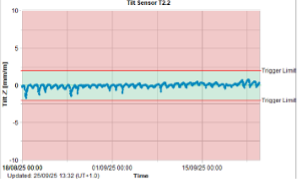
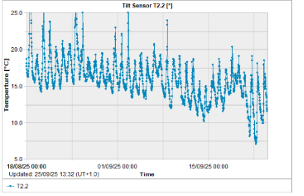
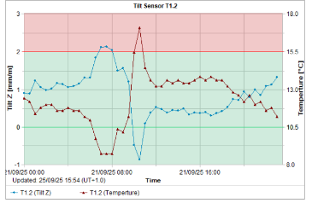
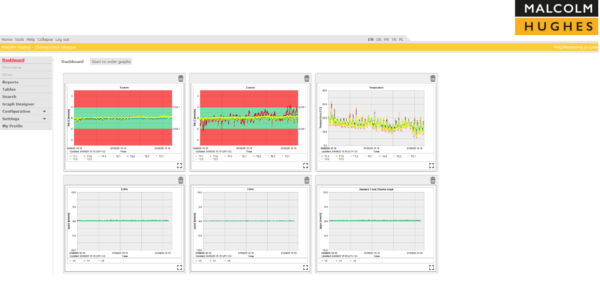
A further challenge lay in the data itself. Early baseline readings indicated that thermal expansion and contraction could cause apparent movement in the wall, potentially triggering false alerts. Without careful calibration, these environmental effects could lead to unnecessary work stoppages, lost time, and additional costs. The client therefore required a precision-engineered monitoring solution capable of distinguishing genuine structural movement from normal environmental variation, providing confidence, accuracy, and control throughout this demanding project.
Our Solution
To protect the retaining wall and maintain operational confidence, Malcolm Hughes deployed a dual sensor monitoring system combining precise tilt and vibration measurement.
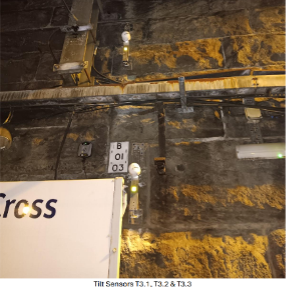
Installed within a live railway environment under strict Network Rail constraints. (Collaboration was crucial with Network Rail to secure the necessary site possession windows for installation) The system continuously captures and transmits data via a secure 4G network, providing the client with real-time visibility of the structure’s stability.
Our data specialists conducted in-depth baseline analysis to differentiate between thermal-derived false positive observations and genuine structural change. This insight enabled us to recalibrate trigger thresholds before demolition began, preventing false alerts and unnecessary work stoppages. By refining sensor configurations and optimising data transmission, we delivered a robust, low-maintenance monitoring solution that will perform reliably throughout the project’s high-risk phases, ensuring structural stability and peace of mind for all stakeholders.
Results and Benefits
- Structural Confidence Maintained – Continuous, precision-led monitoring ensures the stability and integrity of the retaining wall throughout high-risk demolition phases.
- False Alerts Eliminated – Advanced baseline analysis distinguished environmental movement (that was thermally induced) from genuine structural change, preventing costly work stoppages once the work begins.
- Site-Specific Calibration – Trigger thresholds were refined to reflect real-world conditions, delivering reliable, accurate alerts tailored to the site environment.
- Seamless Operation in a Live Railway – The dual sensor system was deployed and maintained safely within strict Network Rail possession windows.
- Optimised Data Performance – Refined vibration sensor settings reduced unnecessary data traffic, ensuring stable 4G connectivity and smooth system performance.
- Autonomous, Real-Time Insight – All sensors operate independently, transmitting live data to give the client continuous visibility and complete confidence in structural stability.
Tools + Technology
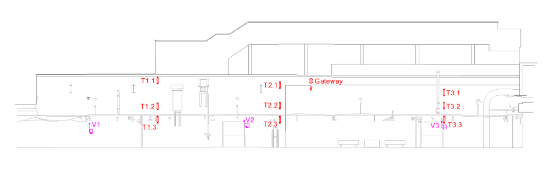
- Nine Tilt Sensors were used, recording rotation on two axes and temperature. The data is measured in degrees (o) and converted to millimetres of rotation per metre (mm/m). The sensors used were Senceive Nano tilt sensors affixed to beams and Eecm OMNI DOTS SWARM SENSORS.
- All sensors transmit data autonomously via a local FlatMesh network and are relayed via the site gateway to the server using the 4G mobile network
- Based on a baseline analysis, trigger thresholds for specific sensors will be recalibrated and reviewed prior to commencing demolition. Baseline readings commenced on 18/08/2025.
Summary
Our experience has shown that every monitoring project is unique. Shaped by its location, environment, and construction activity. This project is a strong example of Malcolm Hughes’ ability to deliver intelligent, precision-led monitoring in some of the most demanding environments. Working within the strict operational constraints of a live railway setting, our team successfully deployed and maintained a dual-sensor system.
Combining tilt and vibration monitoring, on a critical retaining wall infrastructure. Our advanced data analysis techniques allowed us to separate natural environmental effects, such as temperature variations, from true structural movement, ensuring that trigger thresholds were accurately calibrated to reflect real-world risk.
By proactively interpreting baseline data and recommending timely sensor recalibration and system refinements, we helped our client minimise potential disruption and maintain full confidence in structural stability throughout the high-risk demolition phases. This project showcases our technical depth, agility, and commitment to safeguarding client operations through tailored, data-driven solutions.